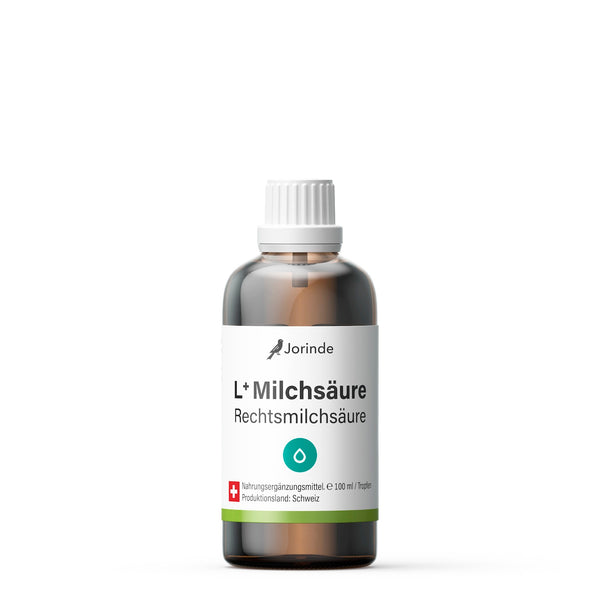
Right-handed lactic acid (L+ lactic acid) is a natural, endogenous active ingredient that we offer in a highly concentrated, liquid form (20%) for internal use. In naturopathy, it has long been used to support gut health, acid-base balance, and general well-being.
Below, we answer the most important questions about it: what benefits right-handed lactic acid offers, what exactly happens in the body, and what the current scientific evidence says.
What are the benefits of right-handed lactic acid?
Right-handed lactic acid supports several areas of the body – usually as part of a more comprehensive detoxification or gut cleanse.
- Gut environment: supports the restoration of a healthy gut environment, especially valuable as part of a gut rehabilitation.
- Gut flora buildup: suitable as a preparation, for example, in combination with pre- and probiotics.
- Acid-base balance: can contribute to its balance.
- Gut cleansing: helps to displace harmful fungi and bacteria in the gut.
- Cell metabolism: supports its regulation.
- Vitality: is traditionally associated with the reactivation of adrenaline secretion.
- Combinability: is well suited for combination with an antifungal treatment, probiotic treatment, or acid-base treatment.
What does right-handed lactic acid do in the body?
Lactic acid exists in two mirror-image forms – L(+) and D(-) – which the body processes differently. This is also why the right-handed form is specifically used.
Human metabolism produces almost exclusively L(+)-lactic acid during energy production; it circulates in the blood at a concentration about a hundred times higher than the D(-) form.1 The body can efficiently convert L(+)-lactic acid back into glucose or energy via the liver – whereas the breakdown of D(-)-lactic acid requires a separate, significantly slower enzyme.2 Accordingly, the L(+)-form is attributed with better tolerance.
- Is traditionally associated with the activation of the body's own adrenaline secretion.
- Is said to counteract metabolic derailment.
- According to experience, it can dissolve or prevent the clumping of erythrocytes (red blood cells), which improves blood flow.
- Is associated with maintaining the cell membrane potential.
- This is important for the sodium-potassium pump of the cells and thus for smoothly running metabolic processes.
How does right-handed lactic acid reduce overacidification in body tissue?
The overacidification of the body is considered a widespread phenomenon of our time in naturopathy, caused by environment, lifestyle, and diet. Right-handed lactic acid can support the body in several ways:
- Relieves the body of excess acids by restoring the gut environment.
- Can contribute to correcting the blood pH value.
- Helps to excrete increased amounts of left-handed lactic acid (D-lactic acid) that would otherwise accumulate in the tissue.
- Is efficiently metabolized by the body without causing additional acid load.
- Stimulates the formation of buffer substances such as bicarbonate.
- In healthy people, noticeable relief usually occurs after only 14 days of use.
Why an acid can still de-acidify the body
This sounds contradictory at first: How is an acid supposed to help rid the body of acids? The answer lies not in the property of "acidic" itself, but in what happens to the molecule in further metabolism.
Not every acid burdens the body to the same extent. Fixed acids like sulfuric acid, which is formed during the breakdown of sulfur-containing amino acids from proteins, cannot be further utilized by the body – it must be buffered and excreted via the kidneys. Organic acids like lactic acid work differently: If the liver breaks down L(+)-lactic acid – via gluconeogenesis (Cori cycle) to glucose or completely oxidized in the citrate cycle to CO₂ and water – this process consumes one proton (H⁺) per molecule. This chemically corresponds to the provision of bicarbonate.3 The resulting CO₂ is then simply exhaled via the lungs, instead of accumulating as a fixed acid in the tissue.
The same effect is known from citric acid: It tastes sour, but from a nutritional science perspective, it is considered "base-forming" because it is converted into bicarbonate in metabolism.4 Following the same principle, right-handed lactic acid can also relieve the body overall despite its own acidic pH value, instead of burdening it additionally.
How does right-handed lactic acid help build a healthy gut flora?
A balanced pH value in the gut is an important prerequisite for beneficial bacteria to be able to settle there in the first place.
- Regulates the pH value in the gut, which is crucial for the colonization of beneficial bacteria.
- Thus creates good initial conditions for gut flora development, for example, in combination with pre- and probiotics.
- Can promote the growth of lactic acid bacteria such as lactobacilli.
- Contributes to the regeneration of a weakened gut flora.
- Lactic acid bacteria are generally attributed with having a positive effect on digestion, the immune system, and metabolism – a field of research that has grown significantly in recent years.5
- Since a large part of the immune cells are located in the gut, the immune system also benefits from this.
How does right-handed lactic acid help eliminate harmful microorganisms in the gut?
The use of right-handed lactic acid is highly valued in holistic complementary medicine, especially when it comes to displacing pathogenic germs. The underlying mechanism is now also known from microbiome research: Organic acids lower the local pH value in the gut and thus specifically disrupt the metabolism of unwanted germs, while many beneficial bacteria cope well with the more acidic environment.6
- Can inhibit the growth of anaerobic, pathogenic bacteria.
- Helps to displace yeast fungi and other harmful microorganisms in the gut.
- Lowers the local pH value in the gut, which makes it difficult for many unwanted germs to grow.6
- According to a study by Dr. Oliver Ploss, 97% of users achieved lasting improvement or rehabilitation of the gut environment within 2 to 6 months.7
- Works particularly well in combination with a targeted antifungal treatment.
Right-handed lactic acid is well suited for combination with other Jorinde preparations, such as our pre- and probiotic. Application: Dissolve 20 drops in approx. 250 ml of still water, stir well, and drink three times daily.
Jorinde Right-handed Lactic Acid – click here
Pohanka, M., D-Lactic Acid as a Metabolite: Toxicology, Diagnosis, and Detection, BioMed Research International, 2020. ncbi.nlm.nih.gov/pmc/articles/PMC7320276 ↩︎
L-lactate and D-lactate – clinical significance of the difference, acutecaretesting.org. acutecaretesting.org ↩︎
Metabolic fate of lactate, acetate, citrate and gluconate, Deranged Physiology. derangedphysiology.com ↩︎
Citrate-based dietary alkali supplements available in Germany: an overview, Journal of Pharmaceutical Health Care and Sciences, 2024. ncbi.nlm.nih.gov/pmc/articles/PMC11084099 ↩︎
Disease managing capacities and mechanisms of host effects of lactic acid bacteria, Critical Reviews in Food Science and Nutrition. tandfonline.com ↩︎
Short-chain fatty acids of various lengths differentially inhibit Klebsiella pneumoniae and Enterobacteriaceae species, mSphere, 2024. pmc.ncbi.nlm.nih.gov/articles/PMC10900885 ↩︎
Dr. Oliver Ploss, Effektive Milieusanierung mit Rechtsmilchsäure (RMS), in: Vitale Senioren ↩︎